
Epigraph
•
Nam Sibyllam quidem Cumis ego ipse oculis meis vidi in ampulla pendere, et cum illi pueri
dicerent: Sibylla ti theleis; respondebat illa: apothanein thelo.
•
[I have seen with my own eyes the Sibyl hanging in a jar, and when the boys asked her “What do you want?” She answered, “I
want to die.”]
• —Petronius, Satyricon
Myths and Historical Comments
•
Cumaean Sibyl was the most famous of the Sibyls, the
prophetic old women of Greek mythology; she guided
Aeneas through Hades in the Aeneid. She had been granted
immortality by Apollo, but because she forgot
to ask for perpetual youth, she shrank into withered old age and her authority
declined.]
Burial of the Dead
Epigraph, The Sybil of Cumae
•
Who is the narrator of the
epigraph?
Encolpious, He quotes
Trimalchios boast
•
Who had become
the shrunken insect?
Trimalchios, Cumaean Sibyl
•
What did she delivered from the cave?
Aenied (The gate keeper
of the hell) and Oracles.
•
Trimalchios or Old woman Sybil is hanged upside
down and can’t see the reality.
•
She symbolizes death in life.
Beginning of the Poem
•
begins with an excerpt from Petronius
Arbiter’s Satyricon, in Latin and Greek, which translates as: “For once I saw with
my own eyes the Cumean Sibyl hanging in a jar, and when the boys asked her, ‘Sibyl,
what do you want?’ she answered, ‘I want to die.’”
Explanation
•
Eliot’s opening quotation
sets the tone for the poem as a whole. Sibyl is a mythological
figure who asked Apollo “for as many years of life as there are grains
in a handful of sand” (North,
3). Unfortunately, she did not think to ask for everlasting youth. As a result,
she is doomed to decay for years and years, and preserves herself within a jar. Having asked
for something akin to
eternal life, she finds that what she most wants is death. Death alone offers
escape; death alone promises the end, and therefore a new beginning.
•
Thus does Eliot begin his magisterial poem, labeling his first section “The Burial of the
Dead,” a title pulled from the Anglican Book
of Common Prayer.
Burrial of the Dead
•
Text of the Poem
•
FOR EZRA POUND
IL MIGLIOR FABBRO
Ø April is the cruellest month, breeding
Lilacs out of the dead land, mixing Memory and desire, stirring
Dull roots
with spring rain. Winter kept us warm, covering Earth in forgetful snow,
feeding A little life with dried tubers.
Ø Regeneration , Forgetfulness
Ø Memory, Spiritual Death
Ø Memory and desire give pain, Life in Death
Explanation
•
Ezra Pound was a leading
figure in modernist poetry and Eliot’s good friend.
He often helped Eliot in editing his poems, including “The Waste Land.”
•
Translated from vernacular Italian, the phrase Il miglior
fabbro means “the greater
craftsman” and expresses Eliot’s
humility and recognition of
Pound’s artistry as a poet.
April, Kept us Warm, Memory
and
Desire, Forgetful Snow
•
The poem begins with an unidentified speaker
contrasting spring and winter. The contrast is ironic—a paradox:
the speaker describes April, the month associated
with the return of spring, warmth, and the renewal of life, as causing the
greatest pain, whereas winter snow’s covering the earth “kept us warm”
is a
phrase that suggests comfort and security. April is
cruel, according to the speaker, because it evokes “memory and desire”; the
“forgetful snow” of winter does not. The idea that remembering the past and
feeling desire are now painful experiences to be avoided foreshadows a major
theme in the poem: that World War I and the post-war era, the setting of the
poem, resulted in a deadening of the human spirit. The theme is also suggested
by the title of this section of the poem, “The Burial of the Dead.”
Myth of Egyptian
god of Fertility and
Death
•
Osiris murdered by his brother,
disposed in water
•
Entangled in the tree roots
in the Lebanese port of Babylose, Pillar of the Palace.
•
Married to his sister Isis, She buried him properly and
hacked into 14 pieces, scattered all over Egypt,
and her sister buried them
wherever they found.
•
Introduces the fear of death,
parallel between the life
sequences of plants and man.
•
Suggests that death is required
for new life, you die to
your flesh and are born to your spirit.
•
Fallen garden is Waste Land, Original garden where
there is no longer fear and desire only peace.
Text of the
poem
•
Summer surprised us, coming over the Starnbergersee With a shower of rain; we
stopped in the colonnade, And went
on in sunlight, into the Hofgarten,
And drank coffee,
and talked for an hour.
Bin gar keine Russin,
stamm’ aus Litauen,
echt deutsch. And when we were children, staying at the archduke’s, My cousin’s, he took me
out on a sled,
And I was
frightened. He said, Marie, Marie, hold on tight. And down he went.
In the mountains, there you feel free.
I read,
much of the night, and go
south in the winter.
Marie
• Spiritual Degradation
• Sexual Desire
•
From World of Innocence to World of Experience
• Nostalgia
Historical and Mythical Comment
•
The Starnbergersee, or Lake Starnberg, is a large body
of water south of Munich in Germany. The speaker now recalls life in Germany before
the war and begins
to describe a pleasant summer afternoon.
•
The Hofgarten, German
for “court garden,”
is a popular and historic public garden located in Munich. It is
noted for the colonnade in the garden.
(A colonnade is a row of columns holding up a roof that
are separated from each other by an equal distance.) Whiling away the time in
conversation on a sunny summer day in Germany must be a painful memory for the
speaker after the destruction of the war and perhaps explains her description of spring at the beginning
of the poem.
Historical and Mythical Comments
•
Translated from German,
the sentence reads
“I’m
not Russian at
all, I come from Lithuania, a true German.” It is unclear who is speaking at
this point, because speakers change throughout the poem, often with no notice. The statement could be part of a conversation overheard
in the
Hofgarten. Eliot’s inclusion of foreign languages in
the poem often
serves to capture the atmosphere of a particular setting.
In this case, it emphasizes
the geographical and political elements present in Europe before World War I.
Historical and Mythical Comment
•
The allusion to the arch-duke
likely refers to Austria’s Crown Prince
Rudolph, who was also an archduke and a first cousin to Marie, Countess Larisch,
who appears to be identified here as the speaker.
Eliot met Countess Larisch in Munich either in the summer of 1911 or possibly in 1914 before
World War I began. This passage, as well
as others in the text, seem to reflect conversations Eliot had had with various
people in his life.
•
The passage marks the conclusion of Marie’s two happy memories
of life before the war and indicates her present emotional
state.
Reading
“much of the night” suggests isolation and withdrawal from human relationships, and choosing to “go south in the winter,”
instead of going to the mountains where “you feel free,” suggests no longer
feeling or seeking to feel joy or fulfillment. Marie’s
emotional
state further develops the poem’s themes of disillusionment and the deadening
of the human spirit in the post- war era.
Explanation
•
Summer came all of a sudden, crossing Lake
Starnbergersee in the rain. We sat in the sunny park, drinking coffee and
talking. "I am not Russian at all; I come from Lithuania, a real
German." When we were children, I stayed with my cousin the archduke, and
he took me sledding, and I was scared.
He said to me, "Marie, hold on tight," and
down the hill we went. You feel a
sense of freedom up there in the mountains.
I read all night long, and I travel south when winter comes
Text
•
What are the roots that clutch, what branches grow Out of this stony rubbish? Son of
man,
You cannot
say, or guess,
for you know only
A heap of broken
images, where the sun beats,
And the dead tree gives no shelter, the cricket no relief,
And the dry stone no sound of water. Only
There is shadow under this red
rock,
(Come in under the shadow of this
red rock),
And I will show you something different from either Your shadow at morning striding
behind you
Or your shadow at evening rising
to meet you; I will show you fear in a handful of
dust.
Historical
Comments
•
Reference to Bible,
Spoken by Ezekiel
and Ecclesiastes in Old Testament.
•
Description of Waste land symbolizes spiritual death and spiritual dryness.
•
Red rock means faith in God, only hope to bring spirituality is faith in God.
Text
•
Frisch weht der Wind
Der-Heimat zu Mein Irisch Kind, Wo weilest du?
•
“You gave me Hyacinths first a year ago;
“They called me the hyacinth girl.”
—Yet when we came back, late, from the hyacinth garden,
Your arms full, and your hair wet, I could not Speak, and my eyes failed, I was
neither Living nor dead, and I knew nothing, Looking into the heart of light, the
silence.
Oed’ und leer das Meer.
Myth and Historical Commets
•
“Son of man” is a biblical allusion to Jesus Christ, who often referred to himself
in the New Testament as the
Son of Man, thus clarifying that he was human as well
as divine. In context, “Son of man” can be interpreted
as a new unidentified speaker’s alluding to human beings in general.
•
These German lines may be translated as follows:
“Fresh blows the Wind / towards
home / My Irish Child
/ where are
you now?” Eliot’s notes identify the passage as lines 5–8 of act 1 of Richard
Wagner’s opera Tristan und Isolde. Tristan and Isolde’s enduring love for each other contrasts with the end of the
relationship between
the “hyacinth girl”
and her lover
Explanation
•
described in the following section of the poem.
Translated as “empty and desolate
is the sea,” the passage
is an allusion to the scene in Tristan und Isolde when a dying Tristan
waits for Isolde to return to him. Pairing the classic love story of Tristan
and Isolde with a modern story of the “hyacinth girl,” whose lover is now
incapable of feeling anything at all, supports the poem’s theme of spiritual
death—the idea that even love cannot
survive in the emotional sterility of modern post-war society.
Explanation
•
Can any roots or branches grow out of this stony,
barren soil? As a human being, you
cannot tell me, or even guess, because all you know are the broken symbols of
modern life: a waste land where the
sun is harsh and dead trees offer no shade, crickets no longer sing, and water
does not run. But there is shade
under this red rock
(come stand in the shade under this red rock),
and I will show you something other than your shadow cast behind you in the morning, or in front of you in the
evening; I will show you how to fear the shadow of death. Fresh blows the wind to the homeland; my Irish child, where are you
waiting? "You first expressed your love with a bouquet of hyacinths a
year ago; people called me the hyacinth girl." And yet when we returned
late from the garden, your arms full of flowers and your hair wet, I was
speechless, I could hardly look at you, I felt empty, neither alive nor dead. I looked into your good heart and saw only
silence. Desolate and empty is the sea.
Text
•
Madame Sosostris, famous
clairvoyante, Had a bad cold, nevertheless
Is known to be the wisest
woman in Europe, With a wicked pack of cards.
Here, said she, Is your card, the drowned Phoenician Sailor, (Those are pearls that were his
eyes. Look!) Here is Belladonna, the Lady of the Rocks, The lady of situations.
Text
•
Here is the man with three staves,
and here the Wheel,
And here is the one-eyed merchant, and this card,
Which is blank, is something he carries on his back,
Which I am forbidden
to see. I do not find
The Hanged Man. Fear death by water.
I see crowds of people, walking
round in a ring.
Thank you. If you see dear Mrs. Equitone,
Tell her I bring
the horoscope myself: One must be so careful these
days.
Historical and Mythical Comments
•
The passage introduces the speaker in this section of
the poem, Madame Sosostris, a clairvoyant(e)
or psychic who supposedly can see
the future. Madame Sosostris’s name is an allusion to a character in Aldous
Huxley's
novel Crome Yellow, in which a man disguises
himself as an old
woman and pretends to be a fortune teller. The fortunes he tells are dark and disturbing, and some of them are
similar in
theme to themes in “The Waste Land.”
Associating Madame Sosostris
with the charlatan
in Huxley’s novel implies that she, too, is a fraud
Historical and Mythical Comment
•
Madame Sosostris’s being known as “the wisest woman in
Europe” suggests a major theme in “The Waste Land”: the dissolution of traditional philosophies and the absence of
shared religious beliefs in post-World War I Europe has created a rudderless
society. Her tarot cards are “wicked” because they lead people away from the
truth in their search for some security and meaning in their empty lives.
Historical and Mythical Comment
•
T. S. Eliot's
speaker seems to be illustrating the kinds of superstitions that would revive following the
dissolution of traditional religion. In the absence of shared religious
beliefs, mankind might revert to ancient beliefs in such things as fortune
telling, astrology, numerology, palm reading, and spiritualism (communing with
the
dead). Madame Sosostris represents a figure who offers
these rituals.
Historical and Mythical Comment
•
This line is taken from a song sung by Ariel, a spirit,
in act 1, scene 2 of Shakespeare’s The Tempest; through the song, she lies
to Ferdinand, telling him that his father died in the shipwreck that Ferdinand
survived. The inclusion of the line with its subtle allusion to Ariel’s lie implies once
again that Madame Sosostris is a deceitful fraud.
Historical and Mythical Comment
•
A horoscope predicts
someone’s future based on astrology, the study of the
positions of celestial bodies and their influence on human affairs. Astrology and other pseudo-sciences, like
numerology and palm reading, became increasingly popular in the 1920s,
reflecting the diminishing influence of traditional religion, a continuing
theme in the poem.
Symbols on Tarot
Cards
•
The drowned Phoenician sailor: Hope for life
and rebirth, purification by water.
•
Belladonna:
Beautiful lady, the lady of rocks, Lady of situation, Renewal of life by holy grail,
or a seductive woman.
•
The man with
three staves: Three staves of
DA, to give , to sympathize, to control, Signifies the fisher king, Search for spiritual
truth and compassion for others.
Historical and Mythical Comments
•
The wheel: The wheel of fortune, of seasons,
of ups and downs of life, the wheel turns round and round like the crowd of
people walking in a ring, It is symbol of change.
•
One eyed merchant: Mr
Eugenide from Syria who brings merchandise, myths and religion, Hope of change by compassion and
religion, lost eye can be read as lost of religion
Historical comments
and myths
•
The hanged man: Sacrifice of the Christ, Madame
Sosostris says that she doesn’t find the hanged man. He indicates that there is no
renewal for us, that the tradition and religion of the past have been lost.
Explanation
•
Madame Sosostris, the famous fortune-teller, has a bad
cold like any ordinary person, but is somehow still known as the wisest woman
in Europe with her evil deck of tarot cards.
"Here is your card," she said, "The drowned
Phoenician Sailor, with his dead eyes
like pearls, look!" She carried
on, "Here is Belladonna, the beautiful
and poisonous lady, the Madonna of the Rocks, that complex
lady. Here is the man with three staffs,
and here is the Wheel of
Fortune, and
here is the merchant looking sideways at us, and this blank card represents the burdens the merchant carries,
which I am not allowed to see. I cannot find The Hanged Man card. You
should be afraid of death by water. I see crowds of people in your future,
walking aimlessly in circles. Thank you, the reading is over. If you see dear
Mrs. Equitone, let her know I'll come by with her horoscope myself; you can
never be too careful these days."
Text
•
Unreal City,
Under the brown fog of a winter
dawn,
A crowd flowed over London Bridge,
so many, I had not thought
death had undone
so many. Sighs, short and
infrequent, were exhaled, And each man fixed his eyes before his feet.
Flowed up the hill and down King William
Street, To where Saint Mary Woolnoth kept the hours With a dead sound on
the final stroke of nine.
Text
•
There I saw one I knew, and stopped him, crying: “Stetson!
“You who were with me in the ships at Mylae! “That corpse you planted last
year in your garden,
“Has it begun to sprout?
Will it bloom this year?
“Or has the sudden frost disturbed its bed?
“O keep the Dog far hence,
that’s friend to men,
“Or with his nails he’ll dig it up again!
“You! Hypocrite lecteur!—mon semblable,—
mon frère!”
Theme
•
Death in life
•
Aimless wandering
•
Painful routine
•
Soulless living of modern life.
•
Reference of great naval battle of 260 BC between
Rome and Carthage.
•
Stetson represents humanity
of all time.
•
Dog symbolizes spiritual awareness and conscience.
•
Keeping it away suggests that modern man doesn’t want to
live with spirituality and morality.
•
Last line suggests
that for this spiritual degradation you, me and all are
responsible.
Historical Comments
and Myths
•
Beginning with Marie’s memories of Munich before World
War I, the poem’s setting shifts to
London after the war, evidenced by the following allusions to London Bridge,
King William Street, and Saint Mary Woolnoth, a centuries-old Anglican church
located on the corner of Lombard Street and King William Street in the City of London. The change in setting emphasizes that the disastrous effects of
the war are not confined to the European continent.
Historical Comments
and Myths
•
This is a direct quotation from Canto
III of The Inferno by Dante Alighieri (1265-1321). In The Inferno, Dante remarks "I had not thought death had undone so many" after
entering the gates of Dis, the
subterranean city of the dead. Thus, Eliot's allusion equates London to hell
and the throngs of Londoners to the countless dead. The comparison is
metaphorical, for the Londoners are not literally dead, but perhaps spiritually
so.
Historical Comments
and Myths
•
The auditory imagery in these lines
comes
directly from
Eliot’s experience; in his notes, he observes that that the sound is “a
phenomenon which I have often noticed.” The church bell’s “final stroke of
nine” can also be interpreted as a biblical allusion to the time of Jesus
Christ’s death on the cross,
recounted in the Gospel of Mark 15:33. The allusion and the connotations of
“dead” in describing the sound of the bell contribute to the sense of
hopelessness and resignation in this section of the poem, as foreshadowed by
its title.
Historical Comments
and Myths
•
Mylae, an ancient Mediterranean port in northeast
Sicily, was the site of a fierce naval battle in 260 BCE between Carthage, a
city state, and the Roman Republic; the Roman forces won, conquering Carthage. Since the speaker and Stetson,
his unidentified acquaintance, obviously didn’t fight in the ancient battle, the statement serves
no literal purpose;
instead, it perhaps suggests the idea that wars are as old as humankind
and are a repeating cycle throughout history. In that regard, World War I—“the war to end all wars”—will have accomplished
nothing except to precede the wars to come.
Historical Comments
and Myths
•
The passage is an allusion to John Webster's poem
"Funeral Dirge for Marcello," from his play The White Devil (1612), which describes the “friendless bodies of unburied men”
being
interred in “shady groves” as they are “covered
with leaves and
flowers.” In Webster’s poem, a wolf “that’s foe to men” must be kept away from
the graves. In Eliot’s amended version, a dog “that’s friend to men” is equally
destructive, perhaps implying that neither friends nor foes respect the dead, a
claim illustrated by
humankind’s history of relentless warfare.
Historical Comments
and Myths
•
This is an allusion to John Webster's poem
"Funeral Dirge for Marcello." With its darkly comic meditation on
death, Webster's poem matches
the gloomy mood of Eliot's.
The poem is as follows:
•
Call for the robin-redbreast and the wren, Since o'er
shady groves they hover,
And with leaves and flowers do cover The friendless bodies of unburied men. Call unto his funeral dole
The ant, the field-mouse, and the mole,
To rear him hillocks that shall keep him warm,
And (when gay tombs are robbed)
sustain no harm; But keep the wolf far thence, that's foe to men,
For with his nails he'll dig them up again.
Historical Comments
and Myths
•
The final line in “The Burial of the Dead” alludes to the final line in Charles Baudelaire's poem, "To the Reader." Translated from the French, it means “Hypocrite reader,—my
fellow,—my brother!” Baudelaire’s poem
develops themes that relate
to those in “The
Waste Land,” primarily the idea that withdrawing from life through inaction,
boredom, fear, pessimism, or acceptance of defeat is worse than death itself.
Historical Comments
and Myths
•
This is an allusion to Charles Baudelaire's 1857 poem
"Au Lecteur." Eliot repurposes Baudelaire's shocking address
to his "Hypocrite reader." Baudelaire's poem ends with the
following stanza:
•
C'est l'Ennui!
L'oeil chargé d'un pleur involontaire, II rêve d'échafauds en
fumant son houka.
Tu le connais,
lecteur, ce monstre
délicat,
— Hypocrite lecteur, — mon semblable, — mon frère!
•
One of many English translations of these lines
is:
•
He is Ennui!
— His eye watery as though with tears, He dreams of scaffolds as he smokes
his hookah pipe. You know him reader, that refined
monster,
— Hypocritish reader, — my fellow,
— my brother!
Explanation
•
In this unreal city, covered by the brown fog of winter
mornings, a crowd of people
streamed across the London Bridge.
There were so many people; I did not realize just how many people were isolated, alienated,
beyond reach. They sighed every now and then, and every man walked with his
eyes cast down at his feet. They
walked up the hill and down King
William Street, to where the church bells at Saint Mary Woolnoth kept time,
striking nine o'clock with a heavy sound. That's
where I spotted someone I knew, and stopped him, calling out, "Stetson! You and I fought together
at the battle of Mylae! That
dead body you planted last year in your garden, is it growing yet? Will it bloom
this year? Or did the sudden frost get to it? Keep out the dog, man's best
friend, or he'll dig it right back
up! You!—yes, you, hypocritical reader—my likeness, my twin—my
brother!"
Game of Chess Introduction
•
According to Eliot’s notes, the title of the poem’s
second section alludes to the game of chess played in act 2, scene 2 of Women Beware Women, a play by Thomas
Middleton (circa 1621). Middleton employs the game of chess device again in A Game at Chess (1624). In both works,
playing chess is associated with the deception, betrayal, rape, and sexual seduction of women. The allusion indicates that this section of the poem will address these themes in some way.
A Game of Chess:
Text
•
II. A Game of Chess
The Chair she sat in, like a burnished throne, Glowed on the marble, where the glass
Held up by standards wrought with fruited
vines From which a golden Cupidon peeped out (Another hid his eyes
behind his wing)
Doubled the flames of seven branched
candelabra Reflecting light upon the table as
The glitter
of her jewels rose to meet it, From satin cases poured in rich profusion.
Comments and Historical myths
•
The section begins with an allusion to a passage in
Shakespeare’s Antony and Cleopatra.
In act 2, scene 2, Enobarbus, Antony’s loyal supporter, describes Cleopatra’s
barge as it bears her toward meeting Antony. The passage is rich in imagery
that emphasizes the wealth,
beauty, and sensuality of the Egyptian queen. Through the allusion, the woman
about to be described is associated with these qualities.
Comments and Historical Myths
•
This line is borrowed from Shakespeare's 1607 play Antony and Cleopatra. In act
II, scene II,
Enobarbus describes the arrival of Cleopatra to greet
Mark Antony as follows:
•
The barge
she sat in, like a burnish'd throne, Burn'd on the water: the poop was beaten gold; Purple the sails, and so perfumed
that
The winds were love-sick with them; the oars were silver,
Which to the tune of flutes kept stroke, and made
The water which they beat to follow faster,
As amorous of their strokes.
Comments and Historical Myths
•
Translated from French, “Cupidon” means Cupid, the god
of desire and erotic love in classical mythology. The description of the
woman’s ornate dressing
table, adorned with golden figures of Cupid suggests
wealth, beauty, and sensuality.
Comments and Historical Myths
•
The visual imagery of light in the first two lines is
further developed in this passage: the mirror of the dressing table reflects
and thus doubles the flames of candles lighting the room and reflects the
“glitter” of jewels on the marble table top. The alliteration in “poured in
rich profusion” draws attention to the phrase and creates a dynamic image of
many jewels cascading from the satin cases that hold them. The imagery
contributes to the atmosphere of wealth, beauty, and privilege in which the woman lives.
Text
•
In vials of ivory and coloured glass Unstoppered, lurked her strange
synthetic perfumes,
Unguent, powdered, or liquid—troubled,
confused
And drowned
the sense in odours; stirred
by the air
That freshened from the window,
these ascended
In fattening the
prolonged candle-flames,
Comments and Explanations
•
The mood and atmosphere change suddenly with the description of the woman’s
“strange synthetic perfumes.”
Being synthetic, they are artificial, implying that they are not authentic or
naturally pleasing to the senses. Her perfumes are
personified; they “lurked”
and are “troubled” and
“confused” as
they overwhelm the sense of smell in “odours,” a word like the others with unpleasant connotations. The
disturbing change in mood and atmosphere suggest
that all is not as it appears to be in the woman’s life.
Text
•
Flung their smoke into the laquearia, Stirring the pattern on the coffered
ceiling. Huge sea-wood fed with copper
Burned green and orange,
framed by the coloured stone, In which sad light a carvèd dolphin
swam.
Above the antique mantel was displayed
As though
a window gave upon the sylvan scene The change of Philomel, by the
barbarous king So rudely forced; yet there the nightingale
Filled all the desert
with inviolable voice
And still she cried,
and still the world pursues,
“Jug Jug” to dirty ears.
Comments and Historical Myths
•
A "laquearia" is an elaborate ceiling made of
recessed panels that often depict a scene of some sort. The ceiling in the room
is ornate, like the rest of the woman’s bedroom. However, the light that illuminates the figure
of a dolphin carved into one of the panels is “sad,” not glowing or glittering,
which
underscores the negative change
in mood and atmosphere in Eliot’s description of
the environment in which the woman lives.
Comments and Historical Myths
•
The passage alludes
to the story of Philomela
in book 6 of Ovid’s Metamorphoses. Kidnapped and raped by her
sister’s husband, King Tereus, Philomela is imprisoned and her tongue is cut
out to prevent her from telling anyone what the king has done. The gods take
pity on Philomela and make her a nightingale, the “change of Philomel”
referenced in the passage. Besides contributing to the darkening mood and atmosphere in this section of the text, the allusion underscores the
notion of sexual violence, which is introduced through implication in the title
of the section, “A Game of Chess.”
Comments and Historical Myths
•
Placing “Jug Jug” in quotation marks suggests that it
represents the sound of Philomela’s voice as the nightingale, making it an
example of onomatopoeia. Birds and their songs appear in various places in the
text, contrasting the natural world of the past with the mechanized industrial
society of the modern world, a new age void of morality and compassion.
Text
•
And other withered stumps of time Were told upon the walls; staring
forms Leaned out, leaning, hushing the room enclosed.
Footsteps shuffled
on the stair.
Under the firelight, under
the brush, her hair
Spread out in fiery points
Glowed into words, then would be savagely
still.
Comments and Historical Myths
•
The description of the setting
ends with this line,
marking a turning point in the text. The auditory imagery indicates that someone is coming to her
room; the following lines imply that the visitor is her lover. The connotations
of “shuffled” in regard to the sound of his footsteps suggest a lack of joy or
enthusiasm; even sexual relationships, it seems, are devoid of emotional
fulfillment or satisfaction. The idea supports a
major theme in “The Waste Land”: that modern
life has deadened the spirit and robbed life of
meaning.
Comments and Historical Myths
•
The lines possibly allude to trench warfare during
World War I. Long, deep trenches were dug by both the Allied
forces and the Germans
to provide shelter as combat raged on the Western Front. The allusion suggests
that the woman’s lover is a soldier returned from the war and anticipates the
introduction of Lil and her husband, Albert, in the second half of section II.
Text
•
“My nerves
are bad to-night. Yes, bad. Stay with me.
"Speak to me. Why do you never speak? Speak.
"What are you thinking
of? What thinking? What?
"I never know what you are thinking. Think.”
•
I think we are in rats’ alley
Where the dead men lost their bones.
Text
•
“What is that noise?”
The wind under the door.
“What is that noise now? What is
the wind doing?”
Nothing again nothing.
“Do You know nothing?
Do you see nothing? Do you remember
“Nothing?”
•
I remember
Those are pearls that were his eyes.
“Are you alive, or not? Is there nothing
in your head?”
Text
•
But
O O O O that Shakespeherian Rag— It’s so elegant
So intelligent
•
“What shall I do now? What shall I do?
I shall rush out as I am, and walk the street
With my hair down, so. What shall we
do tomorrow?
What shall we ever do?”
Text
•
The hot water at ten.
And if it
rains, a closed car at four. And we shall play a game of chess,
Pressing lidless
eyes and waiting
for a knock upon the door.
•
When Lil’s
husband got demobbed, I said—
I didn’t mince my words, I said to her myself,
HURRY UP PLEASE ITS TIME
Now Albert’s
coming back, make yourself a bit smart.
He’ll want to know what you done with that money he gave you
To get yourself some teeth. He did, I was there.
Comments and Myths
•
Eliot employs repetition in the passage, repeating two allusions that appear in the first section of the poem,
“The Burial of the Dead,” lines 37–41 and lines 46–48.
Repeating the allusions during the conversation between
the woman and her lover emphasizes the implied meanings of the allusions
and suggests that they relate to society at large.
Comments and Myths
•
“Demobbed” means discharged from military service. This line introduces the second half of
section II in which an unidentified speaker relates a conversation with a woman
named Lil, whose husband is coming home from the war.
Comments and Myths
•
The line, which is repeated throughout this portion of
the text, refers to the last call at closing time in a bar, the setting for the
conversation that occurred between the speaker
and Lil. The setting contrasts
with the opulence of the
woman’s bedroom in the previous scene and suggests a marked difference in
social class between her and Lil that becomes evident in the lines that follow.
Comments and Myths
•
In context, “smart”
means attractive and
stylish. The
speaker’s admonition implies that Lil is neither,
again differentiating her from the woman in the first half of this
section.
Text
•
You have them all out, Lil, and get a nice set, He said, I swear, I can’t bear to
look at you. And no more can’t I, I said, and think of poor Albert,
He’s been in the army four years,
he wants a
good time,
And if you don’t give it him, there’s others
will,
I said.
Oh is there, she said. Something o’ that, I said. Then I’ll know who to thank,
she said, and give
me a straight look.
Text
•
HURRY UP PLEASE
ITS TIME
If you don’t like it you can get on with it, I said.
Others can pick and choose if you can’t.
But if Albert
makes off, it won’t be for lack
of telling.
You ought to be ashamed, I said, to look
so antique.
(And her only thirty-one.)
I can’t help it, she said, pulling
a long face,
It’s them pills I
took, to bring if off, she said. (She’s had five already, and nearly died of young George).
Comments and Myths
•
This line refers to Lil’s having taken pills to induce
an abortion. The reasons for having taken them and the subsequent consequences are made clear in the following two lines.
Text
•
The chemist said it would be all
right, but I’ve never been the
same.
You are a proper
fool, I said.
Well, if Albert won’t leave you alone, there
it is, I said, What you
get married for if you don’t want children?
HURRY UP PLEASE ITS TIME
Well, that Sunday Albert
was home, they had a hot gammon, And they asked me in to dinner,
to get the beauty of it hot— HURRY UP PLEASE ITS TIME
HURRY UP PLEASE ITS TIME
Goonight Bill.
Goonight Lou. Goonight
May. Goonight. Ta ta.
Goonight. Goonight.
Good night, ladies, good night, sweet ladies,
good night, good
night.
Comments and Myths
•
Gammon is ham that has been cured
or smoked
like bacon.
The passage, which ends the speaker’s
discussion of Lil, suggests that with Albert’s return, Lil’s life proceeded,
her misery unabated, as she resumed her duties as his wife. Like the woman in
the first half of this section of the poem, sexuality for Lil is not a means of
expressing love, and despite the great disparity between their social classes
and lifestyles, both are trapped and isolated in lives with little meaning.
Comments and Historical Myths
•
The closing line is a repetition of Ophelia’s words in act 4, scene 5 of Hamlet as
she leaves Gertrude and
Claudius; in a disturbed mental state, Ophelia drowns shortly thereafter. The
allusion underscores the “death by water” motif in “The Waste Land.” It also
exemplifies Eliot’s inclusion of allusions to and excerpts from classical works
of literature, placing “The Waste Land,” a modernist poem, in the wider context
of Western literature.
•
The Waste Land Summary
and Analysis of Section II: "A Game of
Chess"
•
The second section of "The Waste Land"
begins with a description of a woman
sitting on a beautiful chair that looks
“like a burnished throne” -– a nod to Cleopatra in Antony and
Cleopatra. She occupies a splendid drawing room, replete with coffered
ceilings
and lavish
decorations. The setting
is a decidedly grandiose one. We
are not sure who the woman is: perhaps Eliot’s wife Vivienne, perhaps a
stand-in for all members of the upper crust, perhaps simply an unnamed personage whiling away the hours in a candlelit kingdom. Eliot writes of “satin
cases poured forth in profusion,”
“vials of ivory and coloured glass,”
an “antique mantel”
and “the
glitter of […] jewels.”
Both the woman and the room are
magnificently attired,
perhaps to the point of excess.
•
One of the paintings in the room depicts the rape of Philomela, a scene pulled from
•
Ovid’s Metamorphoses. In the original
story, King Tereus’s
wife bids him to bring her
sister Philomela to her. Upon meeting Philomela, Tereus falls instantly and hopelessly in love; nothing
must get in the
way of his conquest. Racked with lust, he steals away with her and rapes her in
the woods –- the "sylvan scene” Eliot mentions. He then ties her up and
cuts off her tongue so that she may not tell others of what has happened. He returns to his wife, but
Philomela is able to weave on a loom what has befallen her; she gives
the loom to her sister, who, upon discovering the truth, retrieves Philomela,
slays Tereus’s son, and feeds his carcass to the king. When he
finds out that he has been served his son for dinner, Tereus flies into a rage,
chasing both Philomela and his wife out of the palace, and all three of them
transform into birds. The speechless Philomela becomes a nightingale.
•
Snatches of dialogue
follow. It seems plausible that the
woman in the room is addressing the narrator. She complains that her nerves are
bad, and requests that he stay with her. When she asks him what he is
thinking, the narrator retorts,
“I think we are in rats’
alley /
Where the dead men lost their bones.” Still more harried questions follow;
the woman demands
to find out whether the narrator knows “nothing,” then asks what she
should do now, what they should do tomorrow. The narrator answers with a rote itinerary: “The hot water at
ten. / And if it rains, a closed car at four. / And we shall play a game of
chess, / Pressing
lidless eyes and waiting
for a knock upon the door.”
•
The last stanza
of the section depicts two Cockney women talking in a pub at closing time –
hence the repeated
dictum:
“HURRY UP PLEASE IT’S TIME.” The subject of conversation is a certain Lil,
whose husband Albert was recently released from the army after the war. He gave Lil money to get a new set of teeth,
but she has hesitated: “You ought to be ashamed, I said, to look so antique
[...] I can’t help it, she said,
pulling a long face." Lil is apparently on pills, unhappy in her marriage, and mother to none. The dialogue grows more fractured and the
closing time announcements become more frequent, and finally the stanza
devolves into a quotation from Hamlet: Ophelia’s final words to
Claudius and Gertrude, “Good night ladies, good night, sweet ladies, good
night, good night.”
•
Analysis
•
This section once again ushers in the issue of
biographical interpretation. It is tempting to read the woman on the “burnished
throne” as Eliot’s wife, Vivienne; the passage then becomes a dissection of
an estranged relationship. Some of the details point to failed romance or
failed marriage: the “golden Cupidon” who must hide “his eyes behind his wing,”
the depiction of Philomela’s rape –- an example of love
cascading into brutality and violence -–
and even the woman’s “strange synthetic perfumes” drowning “the sense in
odours.”
•
Again the word “drowned” appears,
and with it comes the specter of death by water.
In this case, the thick perfumes seem to blot out authentic
sensations, just as the splendid decorations of the room appear
at times more menacing than beautiful. The trappings of a wealthy modern life
come at a price. The carving of a dolphin is cast in a “sad
light.” The grandiose portraits and paintings on the wall are
but
“withered stumps of time.” By the end of this first stanza, the room seems
almost haunted: “staring forms / Leaned out, leaning, hushing the room
enclosed.” The woman, for her part, is a glittering apparition, seated upon her Chair (Eliot capitalizes the word as if it were a kingdom)
like a queen, recalling Cleopatra -– and thus yet another failed love affair.
•
First Tristan and Isolde, now Cleopatra: twice now
Eliot has alluded to tragic romances, filtered
from antiquity through more modern sensibilities -– first that of Wagner, the great modernizer of opera, and then that of Shakespeare, perhaps the first
“modern” dramatist. Quotation and allusion is of course a quintessential
component of Eliot’s style, particularly in "The Waste Land"; the
poem is sometimes criticized for being too heavily bedecked in references, and
too
dependent on
previous works and canons. The poet’s trick is to plumb the old in order to
find the new. It may seem at first ironic that he relies so much on Ovid, the
Bible, Dante, and other older works of literature to describe the modern age,
but Eliot’s method is an essentially universalist one. Just as the Punic War is
interchangeable with World War I -–
the truly “modern” war of Eliot’s time -– so can past generations of writers and thinkers shed light on contemporary life. Eliot’s
greatest model in this vein was probably Ulysses,
in which James Joyce used Homer’s epic as a launching pad for a dissection of
modern Dublin. In contrast to modernist poets such as Cendrars and
Appollinaire, who used the choot-choot of trains, the spinning of wheels, and
the billowing of fumes to evoke their era, or philosophers such as Kracauer and
Benjamin, who dove into the sports shows and the arcade halls in search of a
lexicon of the modern that is itself modern, Eliot is content to tease
modernity out of the old.
•
This is not to say that "The Waste Land" is
free of the specifics of 1920s life, but rather that every such specific
comes weighted with an antiquarian reference. When Eliot evokes
dance-hall numbers and
popular ditties, he does so through the “Shakespeherian Rag.” When he imitates
the Cockney talk of women in a pub, he finishes the dialogue with a quotation
from Hamlet, so that the rhythms of
lower-class London speech give way to the words of the mad Ophelia.
•
That said, “A Game of Chess” is considerably less
riddled with allusion and quotes than “The Burial of the Dead.” The name itself
comes from Thomas Middleton’s seventeenth-century
play A Game of Chess, which posited the said game as an allegory to describe
historical machinations –-
specifically the brewing conflict between England and Spain. What might the
game allegorize for Eliot? He offers it up as one of several activities, when
the woman demands: “What shall we ever do?” Simply a slot in a strict
numerical ordering
of the day, chess recalls
“lidless eyes,” as its players
bide the
time and wait “for a knock upon the
door.” We are not far removed from the masses crowding London Bridge, their
eyes fixed on their feet. Modern city-dwellers who float along in a fog are
neither dead nor living; their world is an echo of Dante’s Limbo. Chess belongs
therefore to this lifeless life; it is the quintessential game of the wasteland,
dependent on numbers and cold strategies, devoid of feeling or human contact.
Interaction is reduced to a set of movements on a checkered board.
The Fire Sermon
Text
•
The river’s tent is broken;
the last
fingers of leaf
Clutch and sink into the wet bank. The
wind
Crosses the brown land,
unheard. The nymphs are
departed.
Sweet Thames,
run softly, till I end my
song.
The river bears no empty bottles, sandwich papers,
Silk handkerchiefs, cardboard boxes,
cigarette ends
Or other
testimony of summer nights. The nymphs
are departed.
And their friends, the loitering heirs
of City directors;
Departed, have left no addresses.
•
नदी का तम्बू टू ट गया है; पत्ती की आखिरी उं गलियां चिपक जाती हैं और गीिे ककनारे में डू ब जाती हैं। हवा भूरे रंग की भूलम को पार करती है, अनसुना। अप्सराएँ ववदा हो गईं। प्यारी टेम्स, जब तक मैं अपना गाना ख़त्म नहीं कर िेता, धीरे-धीरे दौडो। नदी में कोई िािी बोतिें, सडववि पेपर, रेशमी रूमाि, गत्ते के बक्से, लसगरेट के लसरे या गमी की रातों का कोई अन्य प्रमाण नहीं है। अप्सराएँ
ववदा हो गईं। और उनके दोस्त,
शहर ननदेशकों के आवारा वाररस;
ििा गया, कोई पता नहीं छोडा।
Allusions and Quotations
•
The title of section III alludes to a sermon by the
Buddha in which he urges his listeners to turn
away from physical
passion (lust) and the
love of worldly pleasures. Through the allusion, Eliot indicates the content of
this section of the poem.
•
“The river’s tent” is an implied metaphor that
describes the leafy branches of trees along the
riverbank. The image suggests that they extend over the water. The tent is
“broken” because the leaves, which are personified as having “fingers” that
“clutch” the branches, have fallen. The imagery establishes the setting—a place
beside a river during late autumn, and a bleak—depressing atmosphere.
•
The river mentioned previously is now identified as the
Thames, which runs through London and southern
England. The line is a refrain in Edmund
Spenser’s poem “Prothalamion”; Spenser’s subject is a lovely double wedding on
a summer day by the Thames, and the poem is filled with images of happiness and
natural beauty. The
allusion is ironic,
considering Eliot’s previous
description of the Thames
and the silent
“brown land” nearby, and it anticipates other ironic contrasts that
are developed throughout section III.
•
In classical mythology, nymphs are minor spirits
represented as beautiful maidens who live in nature. “The nymphs are departed,” a repetition of line 3 above, is
another allusion to “Prothalamion.” In Spenser’s poem, nymphs gather flowers to
adorn the brides-to-be. In the context of this passage, “nymphs” likely refers
to prostitutes who had sexual encounters during the summer with the idle sons
of prominent men in London. The allusion reflects the condemnation of lust suggested by the title of
section III. It also contrasts the beauty of the Thames as described in
Spenser’s poem (1592) with the ugliness and degradation of the river’s present
condition. The contrast supports Eliot’s theme of spiritual emptiness in modern
society.
•
In these lines, Eliot vividly
paints a picture
of someone sitting on the bank
of the famous Thames River in London. Leaves have fallen and have "s[u]nk
into the wet bank" (174). That's what he's referring to the river's tent's
being broken. There are no longer any leaves overhead, acting as a canopy.
•
The overall tone, as you might expect, continues to be
pretty dreary. But there's a lot of wetness in this scene, compared to the dryness and
drought-like quality of earlier sections with all those shadows and red rock.
•
The most significant part of these lines comes with the
phrase, "The wind / Crosses the brown land, unheard. The nymphs are
departed" (175). The nymphs he's talking about are probably the Naiads, or nymphs of the river, according to Greek mythology. This line tells us that the magic is
now gone from what used to be a very magical
place, a place that inspired poets to write about love and beauty.
•
Now, you've just got an empty wind in an empty
place.
•
Allusion alert. The line "Sweet Thames, run softly,
till I end my song" is a line from a poem called "Prothalamion" by Edmund Spenser (1552-1599) that celebrates marriage along the Thames.
•
Eliot is suggesting to us, though,
that Spenser's Thames
was very different than the
one of Eliot's time, which is polluted
with "empty bottles, sandwich papers, / Silk handkerchiefs, cardboard
boxes, cigarette ends" (177-178).
•
Yeah, we know: Eliot says, "the river bears no [litter]" (emphasis added),
but that's actually
a sarcastic remark, meaning that all the litter is there now, but wasn't in Spenser's
time. That Eliot's a confusing guy.
•
But he's not so confusing that he's writing a poem
called "The Waste Land" about a river that's...clean.
•
The people who've left this stuff behind aren't just the riff-raff, either,
but are probably the "heirs of city directors" (180),
meaning that even people of privilege
have turned to slobs in the 20th century.
•
And along with the litter
replacing the scenic
riverbank, the nymphs have been replaced
by these city directors,
who sound way less awesome, seeing as how they make the river all polluted and
gross.
•
Welcome to the Modern World,
everyone. Wear close- toed shoes, please.
Text
•
By the waters of Leman
I sat
down and wept…
Sweet Thames, run softly till I end my song,
Sweet Thames, run softly, for I speak not loud or long.
But at my back in a cold blast I hear
The rattle of bones, and chuckle spread from ear to ear.
•
िेमन के पानी के पास मैं बैठ गया और रोने िगा... स्वीट टेम्स, जब तक मैं अपना गाना ित्म नहीं कर
िेता, धीरे-धीरे दौडो, स्वीट टेम्स, धीरे-धीरे दौडो, क्योंकक मैं जोर से या िबे समय तक नहीं बोिता। िेककन मेरी पीठ पर एक ठं डे
धमाके में मझे हड्डडयों की
िडिडाहट और
कानों से
कानों तक फै िती हंसी
सनाई देती है।
•
“Leman” is the French name for Lake Geneva
in Switzerland. Eliot wrote much of “The Waste Land” while convalescing in
Lausanne by the lake. The line is also an allusion to Psalm 137, which
describes the Israelites
being exiled
to Babylon: “By the rivers of Babylon, there we sat down, yea, we wept,
when we remembered Zion.” The allusion support the poem’s themes of loss and
despair following World War I.
•
Eliot's speaker claims, "By the waters of Leman I
sat down and wept…" (182), which might
hint at the weeping that the Hebrews
did when they stopped by the rivers
of Babylon and remembered
Zion, the homeland they were exiled
from. Check out Psalm 137 for more.
•
But Lac Léman, or Lake Geneva, is also a very
important lake western Switzerland, so Eliot could be alluding to that as well, although we don't know what anyone
in Switzerland has to weep about. They've got great chocolate.
•
If you want to go the more general route,
this line could also just be
the speaker of this poem being really depressed about the world. The use of
ellipsis (…) at the end of this line also contributes to the overall lack of
closure that you get throughout. The speaker is trailing off, unsure of where
he's going.
•
After this, you get the line from the Spenser poem
repeated twice, followed by a sudden mention
of "But at my back in a cold blast I hear /
The rattle of bones, and chuckle spread from ear to ear" (185-186).
•
There's something super creepy about these lines, as
though some violent person is standing right
behind the speaker,
ready to do something
awful, and enjoy it. Yikes.
•
And there's also something eerily
familiar…but
we'll get to that in just a bit.
Text
•
A rat crept softly
through the vegetation
Dragging its slimy
belly on the bank
While I was fishing in the
dull canal
On a winter
evening round behind the gashouse
Musing upon the king my brother's wreck
And on the king my
•
एक िूहा धीरे-धीरे वनस्पनत के बीि से रेंगता हुआ अपने पतिे पेट को ककनारे पर घसीटता हुआ
ििा गया, जब मैं सुस्त
नहर में मछिी पकड रहा था, एक सर्दियों की शाम को गैसहाउस के पीछे घूम रहा था और राजा के बारे में सोि रहा था कक मेरे भाई की बबािदी और राजा
के सामने मेरे वपता की
father's death before him.
मत्यु हो गई
•
The passage alludes to Ferdinand’s speech prior to
Ariel’s song in act 1, scene 2 in The Tempest
and to the Fisher King.
In legends of the Holy Grail, the Fisher King is the
last in a long line of characters charged with keeping and protecting the Holy
Grail; he is always depicted as being wounded. Characters in “The Waste Land”
often merge one into
another, as with Ferdinand and the Fisher
King merging in this passage.
•
A disgusting, slimy rat crawls into the Thames while the speaker is fishing and thinking
about "the king my brother's wreck" (191).
•
While the rat provides the pitch-perfect image for the decay that's going on in society in Eliot's
time, we're more interested in this wreck.
•
It turns out that this line refers to an early scene
from Shakespeare's The
Tempest, in which the magician Prospero summons an insane storm to wreck his brother's ship.
Prospero takes revenge because his jealous
brother marooned him on an island twelve years earlier so that he
(the brother) could be king.
•
This reference conveys the sense of being stranded, just as Eliot feels stranded
and without hope in the
modern world.
Text
•
White bodies
naked on the low damp ground And bones cast in a little
low dry garret,
Rattled by the rat's foot only, year to year.
•
ननििी नम ज़मीन पर नग्न सफे द शरीर और थोडी नीिी सूिी गेरेट में ढिी हड्डडयाँ, केवि
िूहे के पैर से, साि-दर- साि र्हिती रहती हैं।
•
The "White bodies naked on the low damp
ground" (193) could refer to the people
killed by Prospero's storm, or actual dead bodies lying along the bank
of the Thames.
•
Then you hear about the bones that are scattered in a "low, dry garret" somewhere, a garret being a little attic.
•
These bones mostly just gather dust, and are disturbed by "the rat's foot only, year to year"
(195). So in
case you haven't gotten the point yet, Eliot really wants you to know that the
Thames and London is no longer the awesome
beautiful place that some poets have made it out to be. Now it's got litter and dead bodies. Lovely.
Text
•
But at my back from time to time I hear
The sound of horns and motors, which shall bring Sweeney to Mrs Porter in the spring.
O the moon shone bright
on Mrs Porter
And on her daughter They wash their feet in
soda water
Et O ces
voix d'enfants, chantant dans la coupole!
•
िेककन समय-समय पर मुझे अपनी पीठ पर हॉनि और मोटरों की आवाज़ सुनाई देती है, जो वसंत ऋतु में स्स्वनी को श्रीमती पोटिर के पास िे आएगी। हे िंद्रमा श्रीमती पोटिर पर और उनकी बेटी पर उज्जज्जवि िमक गया, उन्होंने सोडा पानी में
अपने पैर धोए "और
उन बच्िों की आवाज़, गंुबद में गाते हुए!"
•
The speaker’s reverie is interrupted by the sounds of
traffic along the Thames. This interruption brings the text back to the subject
of prostitution through the reference of Sweeney’s returning to Mrs. Porter
and her daughter in the
spring. The last three lines in the passage originated in an old Australian
drinking song.
•
This line is taken from the end of Paul Verlaine’s poem “Parsifal” and translates as “And
O those children’s voices,
singing in the cupola!” The allusion once more references the legend of the Fisher King; in
Verlaine’s poem, Percival, a knight who has remained physically and spiritually
pure in order to drink from the Holy Grail, heals the wounded Fisher King. The
allusion’s ironic juxtaposition with the preceding lines emphasizes the loss of
innocence and nobility of character in modern times. Also, Percival’s turning
away from lust and physical
passions is consistent with the message of Buddha’s Fire Sermon, referenced in the
title of this section.
•
Allusions abound! Let's
break 'em down.
•
The speaker says that sometimes, he hears the sound of horns and motors,
which will bring someone named Sweeney to someone named
Mrs. Porter in the spring.
•
These lines pretty directly allude to a play called Parliament of Bees by John Day. The lines
in the play describe Actaeon stumbling upon Diana bathing in the woods, drawn there by a noise of
horns and hunting. Only here, Sweeney is figured as a modern-day Actaeon, and
instead of Diana, we get Mrs Porter,
who's bathing in soda water, rather
than, you know, a lovely river.
•
But the phrasing here is also a nod to a very
famous poem, "To His Coy Mistress" by Andrew Marvell, which has a line
in it that goes, "But at my back I always hear / Time's wingèd chariot
hurrying hear." Plus, it's an echo of line 195.
•
Sweeney is a not-so-likeable character from an earlier
Eliot poem called "Sweeney Among the Nightingales," and Mrs. Porter is from a popular song that
was sung by Australian troops during World War I.
•
Lines 199-201 are taken from this song, and once again
they show a sort of mediocre stupidity that keeps ruining
or drowning out the things in the world that are truly great.
•
More than any
other section of the poem, "The Fire Sermon" includes
bits of popular songs to showcase
how low culture has sunken,
just like leaves into the filthy banks of the Thames.
•
Line 202 is written in French, and translates as "And
O those children's voices singing in the dome!" This comes from a work by French
poet Paul Verlaine about a
knight named Parsifal, who has to
resist all sorts of sexual temptations so he can drink from the Holy Grail.
This line might ironically symbolize the fact that modern
people always give in to temptation; they have
no resistance or dignity, and this is one of the reasons the world's been
ruined.
•
Twit twit twit
Jug jug jug jug jug jug
So rudely forc'd
Tereu
Text
•
ट्ववट ट्ववट ट्ववट जग जग जग जग जग जग इतनी बेरहमी से टेरेउ को मजबूर ककया
•
This passage is a repetition of the allusion to the
story of Philomela that appears in section II "A Game of Chess." It
supports the major theme in this section, the spiritual debasement in modern life,
driven by lust and
selfish desires.
•
These lines go back to the story of Philomela, which Eliot alluded to
way back in lines 99-103.
•
That brings us back to the idea of sex as something horrible
and violent, as you can see
with the repetition of "so
rudely forced" (205).
•
And Philomela's nightingale song continues as well,
with a few new notes, too—"twit." To be fair, the "twit"
sounds might also refer to the moronic twits who populate the modern world. Or maybe that's just Shmoop's take.
•
In any case, it's clear that the modern world, with its
crappy, polluted rivers,
is no place for a beautiful song. So instead of the high notes, we
get ugly the ugly onomatopoeias of "twit" and
"jug."
•
Formally, this sudden fragment also has the effect of refrain, because
it's a phrase that Eliot returns to so he can remind us of the fact that beauty
might still be around us, but we're unable to see or hear it (i.e., just as we
don't realize that the nightingale's song is actually Philomela trying to be
heard).
•
Unreal City
Text
•
सर्दियों की दोपहर के भर
Under the brown
fog of a
winter noon
Mr Eugenides, the Smyrna
merchant
Unshaven, with a pocket full of currants
C.i.f. London: documents at sight,
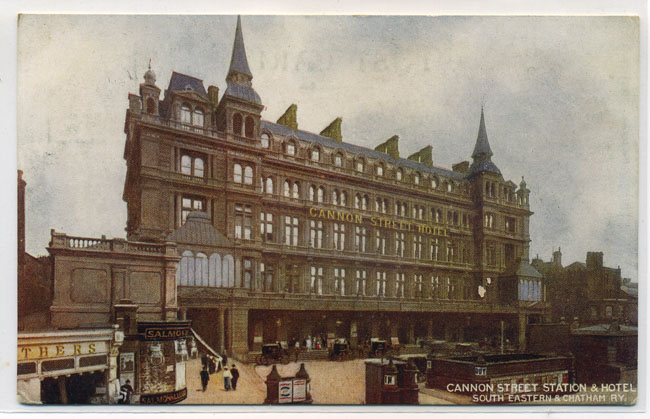
Asked me in demotic French To luncheon at the Cannon Street Hotel
Followed by a weekend at
the Metropole.
कोहरे के नीिे अवास्तववक शहर श्री यूजीनाइड्स, स्स्मनाि व्यापारी अनशेवेन, करंट से भरी जेब के साथ सी.आई.एफ. िदन: दस्तावेज़ नज़र में, मझसे राक्षसी फ़्रें ि में कै नन स्रीट होटि में दोपहर के भोजन के लिए पूछा गया, इसके बाद मेरोपोि में सप्ताहांत बबताने के लिए कहा गया।
•
Another unidentified narrator describes an encounter with a foreign
merchant trading in fruit
in London.
•
Eliot’s notes indicate
that “C.i.f. London”
refers to the price
of currants (dried
fruit) being quoted
as “carriage and insurance free to London”; “documents” refers
to bills of lading presented to buyers upon receipt of goods. The passage indicates that Mr.
Eugenides perhaps has money to spend.
•
In context, “demotic” means common, colloquial, or
slangy. The merchant’s speaking in “demotic French” implies that he is not educated
or refined, as does his being “unshaven.”
•
Cannon Street, which
runs approximately parallel
with the Thames, is the historic center of London and the
city’s financial
district. Numerous hotels are located
on Cannon Street. The Metropole is a London hotel noted
for its many amenities. The invitation suggests
that Mr. Eugenides seeks a
casual sexual encounter with the speaker, supporting the theme of licentious behavior
developed in this section.
•
We return to the idea of the phony, superficial "Unreal city," which is covered by a filthy
"brown fog of a winter noon" (208).
•
We hear a story about some merchant (remember
the merchant from the tarot deck?) from Smyrna (a port city in modern-day Turkey,
now known as Izmir) who is
"Unshaven" and keeps a bunch of dried fruit in his pockets. Guess
he's a snacker.
•
This man asks the speaker
in terrible "demotic French" if the speaker would like to join him for lunch at
the Cannon Street Hotel / Followed by a weekend at the Metropole"
(213-214).
•
These two places were notorious in Eliot's time for
being secret meeting places where men would hook up with one another sexually.
In all likelihood, the puritan
Eliot found this kind of sex
request disgusting, and is using it here as yet one
more sign of how awful Western culture has gotten. There's also a strong hint of racism
in the representation of this
guy from Turkey.
•
Needless to say, we're not meant to look too kindly on this guy.
Text
•
At the violet hour,
when the eyes and back
Turn upward from the desk, when the human engine waits
Like a taxi throbbing waiting,
•
बगनी घंटे में, जब आि और पीठ डस्क से ऊपर की ओर मुडती हैं, जब मानव इंजन इंतजार कर रहा होता है, जसे कोई टैक्सी इंतजार कर रही हो,
•
“The violet hour”
is a metaphor for day’s end;
it evokes the image of a purple sky created by the
setting sun. The metaphor is soon repeated in a following passage,
underscoring the difference between conventional human behavior during a
work day and what it
becomes
after dark. The “human engine” is described with a simile as being “like a taxi
throbbing waiting.” The simile suggests
human passions waiting to be released.
•
These lines set up the coming scene with the blind prophet
Tiresias by talking
about the hour when people look up from their desks
and are just "throbbing" to get home from work.
•
In this instance, you really get a sense of what
beautiful poetry Eliot
can write. He uses cadence here to help this image flow off the page, rather than relying on more obvious
tactics like alliteration or meter.
Text
•
I Tiresias,
though blind, throbbing between two lives,
Old man with wrinkled female breasts, can see
At the violet hour, the evening hour that strives
Homeward, and brings the sailor home from sea,
•
मैं टायलसयस, अंधा होते हुए भी, दो स्जदचगयों क बीि धडक रहा हूं, झुरीदार मर्हिा स्तनों वािा बूढा आदमी,
बगनी घंटे में देि
सकता हूं, शाम का समय जो घर की ओर प्रयास करता है, और नाववक को समुद्र से घर
िाता
है,
•
In Greek mythology, Tiresias is a prophet of the god
Apollo; despite his blindness, Tiresias can see the future. In one of the Greek myths,
Tiresias offends Hera, the wife of Zeus; she turns him into a woman who serves
as her priestess for seven years before being turned back into a man. In his
capacity as a seer, Tiresias narrates the remainder of section III.
•
Enter Tiresias, a prophet from Greek myth whom Eliot calls in his notes "the most important personage in the poem, uniting all the
rest."
•
As the story (which you can find in Ovid's Metamorphoses) goes,
Tiresias was walking along one day, and after he saw two snakes having sex in his path, he hit them with
a big stick, which turned out
to be a huge oh-no-no. The
goddess Hera didn't like that so much, so she transformed him into a
woman for seven years. Awkward.
•
After Tiresias changed
back, Hera made a bet with Zeus about who
enjoyed sex more, women or men. Tiresias said that women did, and Hera totally
freaked out and struck him blind. Zeus felt bad about this, but his hands were tied, so he tried to make up
for it by giving Tiresias the power of prophecy.
•
Weird story, right? So why did Eliot pick this dude as
the most important personage in the poem? It's probably
best to hear it from the horse's mouth, so here's what
Eliot had to say about his inclusion of Tiresias in "The Waste Land":
"Just as the one-eyed merchant, seller of currants, melts into the
Phoenician Sailor, and the latter is not wholly distinct from Ferdinand Prince
of Naples, so all the women are one woman, and the two sexes meet in Tiresias.
What Tiresias sees in fact, is the substance of the poem."
•
So Eliot uses Tiresias in this poem as a sort of
removed observer who can see visions from all over the world and see how awful
the world really is. He's a universal kind of guy. In fact, it's totally
possible that the speaker of this entire
poem is actually
Tiresias, but that's just one
going theory.
•
Tiresias is "throbbing between two lives"
because Eliot portrays him in this poem as a hermaphrodite, a person
who is male and female at the same time. This is what makes him an "Old
man with wrinkled female breasts" (219).
•
Of course that "throbbing" at the "violet hour" is a call back to lines 215-217, allying Tiresias
with these average Joes at their office desks (it's also the hour that Sappho writes about
in her poem "Hesperus, you bring back again," to which Eliot alludes here). He's really the everyman of the poem.
•
And he can see something. What, we're not sure, so we'll
have to keep right on reading.
Text
•
The typist home at teatime,
clears her breakfast, lights Her stove, and lays out food
in tins.
Out of the window
perilously spread
Her
drying combinations touched by the sun's
last rays,
On
the divan are piled (at
night her bed)
Stockings, slippers, camisoles, and stays.
•
िाय के समय टाइवपस्ट घर आती है, अपना नाश्ता साफ करती है, अपना स्टोव जिाती है, और भोजन को डडब्बों में रिती है। खिडकी के बाहर ितरनाक ढंग से फै िा हुआ उसका सिता
हुआ सयोजन, सरज की
आखिरी ककरणों से छु आ हुआ, दीवान पर (रात में उसक बबस्तर पर)
स्टॉककग्स, िप्पि, कैलमसोि
और सामान का ढेर िगा
हुआ है।
•
Tiresias offers us one of his/her visions,
and talks about a young woman
being home from work at teatime and "Lay[ing] out her food in tins" (223), while her laundry dries out the
window.
•
Seems like an everyday image—woman, home, and doing chores. But there's
something oddly depressing about it.
•
For one thing, she's alone. And for another, she's a bit of a slob (she left her breakfast out? and her underwear is lying around?).
Text
•
I Tiresias, old man
with • मैं टायलसय
स, झररियों वािे
wrinkled dugs
Perceived the scene,
and foretold the rest—
I too awaited
the expected guest.
He, the young man
carbuncular, arrives,
A small house agent's clerk,
with one bold stare,
One of the low on whom
assurance sits
As a silk hat on a Bradford
millionaire.
थन वािा बूढा आदमी, दृश्य को समझ गया, और बाकी की भववष्यवाणी कर दी- मैं भी अपेक्षक्षत अनतचथ की
प्रतीक्षा कर रहा था। वह, काबुनकु िर युवक, आता है, एक छोटे से घर के एजेंट का क्िकि , एक ननभीक घूरकर, उन ननम्न िोगों में से एक स्जस पर आश्वासन बैठता है, ब्रैडफोडि करोडपनत पर रेशम की टोपी के रूप में।
•
“Carbuncular” is used as an adjective to indicate that
the man visiting the typist, a young woman who works in
an office, has a carbuncle,
which is a collection of pus-filled boils under the skin. His being so
physically unappealing suggests that his sexual encounter with the typist,
which is about
to be described, will be sordid
•
Just to up the uncomfortable ante, Tiresias makes sure
to mention his wrinkly old breasts again before telling us that he already
knows what's about to happen in this young woman's
apartment. This might be because he's a prophet (thanks, Zeus!) or
because the scene is painfully predictable.
•
Strutting through the front door, "the young man
carbuncular arrives" (231). Carbuncular is a fancy word
for really pimply, which means this guy's probably not all that much to look
at. He doesn't have a very high- paying job,
but he's got a "bold stare" (232) and is way more self-assured than he's got
reason to be.
•
This seems to be another pet peeve of Eliot's: people with no real achievements in life thinking they're totally awesome. For
realsies, thank goodness this man did not live to see the days of reality TV.
•
At this point in the poem, you also find a pretty
strong return of rhyming in Eliot's poem. This might be because Eliot is satirizing the scene as an example of
"modern romance," and using a traditional sense of rhyme to
show how pathetic and gross the scene actually is.
•
It certainly isn't
rhyme-worthy, that's for
sure. The idea here is that the young man carbuncular fancies himself a
classic sexual conqueror (and is as self-assured as a millionaire, even though
he's basically a secretary), but he's just a pimply-faced kid with a pathetic
job and a boring girlfriend.
guesses,
The meal is ended, she is bored and tired, Endeavours to
engage her in caresses
Which still are unreproved, if undesired.
िगाया, भोजन समाप्त हो गया है, वह ऊब गई है और थक गई है, उसे दिार में संिग्न करने का प्रयास ककया गया है जो अभी भी अप्राप्य है, यर्द अवांनछत है।
•
The ugly young man decides
that it's time to make his
move on the girl, since she's probably tired and sluggish after eating her
meal. Yeah, super romantic.
•
Moving in, he "Endeavours to engage her in caresses"
(237). The girl
doesn't really want to have sex with him,
but she basically says "meh" and doesn't really
put up a fight.
•
As you can probably tell, Eliot doesn't think much of
modern romance. It's all just a bunch of poor, uneducated people
having their ugly sex. Hey, he said it, not Shmoop.
Text
•
Flushed and decided, he assaults at once; Exploring hands
encounter no defence; His vanity requires no response,
And makes a welcome
of indifference.
•
घबराकर ननणय लिया, वह तुरंत हमिा करता है; िोजबीन करते हाथों को कोई बिाव नहीं लमिता; उसका घमंड ककसी प्रनतकिया की
मांग नहीं करता, और उदासीनता का स्वागत करता है।
•
The guy goes ahead and "assaults at once"
(239), loving the fact that the girl doesn't
care one way or the other, as long as he gets what he
wants.
•
The rhyming of the lines is as consistent as anywhere in the poem, allowing
Eliot to really
satirize the fantasy of heroic masculinity that the young man has made for himself.
•
Clearly this guy thinks he's the cat's meow, and since
this typist lady couldn't care less, there's no one around to tell him any different. So Eliot makes
it clear that this guy's
actually a schlub with his ironic use of end-rhymes.
Text
•
(And I Tiresias have •
(और मैं टायलसय
स ने
foresuffered all Enacted on this same divan or bed;
I who have sat by Thebes
below the wall
And walked among the
lowest of the dead.) Bestows one final patronizing kiss,
And gropes his way, finding the stairs
unlit …
इसी दीवान या बबस्तर पर सभी कृ त्यों का पूवािभास ककया है; मैं जो दीवार के नीिे थेब्स के पास बैठा था और मतकों में सबसे नीिे ििा गया था।) एक अंनतम संरक्षण िंुबन देता है, और अपना रास्ता टटोिता है, सीर्ढयों को अस्पष्ट पाता है ...
•
The gist here is that Tiresias wishes that he didn't have to watch this sex scene as it plays
out, but his "gift" of visions isn't something he can turn on and
off.
•
Tough break, buddy.
•
He talks about how in the days of ancient Thebes, he used to prophesize by the marketplace's wall and "and walked among the lowest of the
dead" (246), which may be an allusion to the Odyssey or the Inferno, in both of
which Tiresias shows up in the underworld to help a brother (both Odysseus and Dante in turn)
out. And did we mention that Tiresias was also given
seven lives by Zeus?
•
At this point, he gives us one last look at the pimply
young man and his roll in
the hay with the typist.
Now that the young man is finished with his business, he gives the girl
a meaningless "patronizing kiss" (247), and just like the blind prophet,
"gropes his way"
down the stairs because the light is out.
•
Tiresias is able to see what's going on anywhere
in the world, and as Eliot
shows us, this is mostly what it is: bad sex between bad people. A little
harsh, don't you think? Well, Eliot didn't seem to think so.
•
She turns and looks a
moment in the glass, Hardly aware of her
departed lover;
Text
•
वह मुडती है और एक पि के लिए शीशे में देिती है, उसे शायद ही अपने र्दवंगत प्रेमी का एहसास
Her brain allows
one half- formed thought to
pass: "Well now that's done: and I'm glad it's over."
होता है; उसका मस्स्तष्क एक आधे-अधूरे वविार को पाररत होने की अनुमनत देता है: "ठीक है, अब यह हो गया है: और मुझे
िुशी है कक यह ित्म हो
गया है।"
•
Aw, did you think Eliot
was done? No way, he's just getting started.
•
Now that the pimply dude has left, the girl "turns
and looks a moment" in her mirror, "hardly aware of her departed
lover" (249- 250). Calling the guy a "lover" in this scene is
Eliot's way of sarcastically demolishing the idea of modern love, which in his
mind is disgusting.
•
The girl is not all that bright, and her brain only
"allows one half-formed thought to pass," which is "
'Well now that's
done: and I'm glad it's over'"
(252). Gee, how romantic.
•
Eliot is trying to tell us that this girl has no deep
thoughts of any kind, and she doesn't even have enough intelligence to resist
sex that she doesn't
want. She's completely passive in every way, blowing through life like a
shopping bag in the wind.
•
When
lovely woman stoops
to folly and Paces about her room again, alone,
She smoothes her hair
with automatic hand, And puts a record on the gramophone.
•
जब प्यारी मर्हिा मूिता की ओर झुकती है और अपने कमरे में कफर से अके िी घूमती है, तो वह स्विालित
हाथ से अपने बािों को चिकना करती है, और ग्रामोफोन पर एक
ररकॉडि डािती है।
•
In line 253 Eliot quotes from Oliver Goldsmith's novel The Vicar of Wakefield by
quoting a song in
which the main character sings of being seduced and then ditched. Turns out
it's a bit of a bummer.
•
And that corresponds pretty well to our typist's
situation. Now that she's alone again, the woman
just sort of walks around the room without thinking, "smoothes her hair
with automatic hand, / And puts a record on the gramophone" (255-256).
•
The gramophone (or record player) hints at the idea
that popular culture is part of what makes the girl's
life so passive and superficial.
•
If Eliot wrote this poem today, he'd probably have
the girl throw
on an episode of Chopped: All Stars.
Text
•
"This music crept by me upon the
waters"
And along the Strand, up Queen Victoria Street.
O City city,
I can sometimes hear Beside a public bar in Lower Thames Street,
The pleasant whining
of a
mandolin
And a clatter
and a chatter from within
Where fishmen lounge at noon: where the walls
Of Magnus Martyr hold Inexplicable splendour of Ionian white and gold.
•
"यह संगीत मुझे पानी में सुनाई र्दया" और स्रैंड के साथ, क्वीन ववक्टोररया स्रीट तक। ओ लसटी शहर, मैं कभी-कभी िोअर टेम्स स्रीट में एक सावजननक बार क बगि में, मडोलिन की सुिद ध्वनन और भीतर से एक
िडिडाहट और एक बकबक सुन सकता हूं जहां मछु आरे दोपहर में आराम करते हैं: जहां मैग्नस शहीद की दीवारें आयोननयन सफे द रंग की अवणनीय शोभा रिती हैं और सोना।
•
This line alludes to a song, a “melancholy air,” sung by Olivia Primrose in Oliver Goldsmith’s
novel, The Vicar of Wakefield. Seduced and then betrayed, Olivia sings that to
conceal “her guilt” and “hide her
shame,” a woman’s only recourse in these circumstances “is to die.”
In context, the allusion ironically underscores
Eliot’s themes in this section regarding sex in the modern world: that it has
become casual and meaningless. The allusion also underscores the idea that
modern society has become unmoored from a sense of moral decency.
•
“Magnus Martyr” is an allusion to the St. Magnus the
Martyr church, located in Lower Thames Street near the original site of London
Bridge. “Splendor” means a magnificent, glorious appearance, and “Ionian”
refers to columns designed in the style of classical Greek architecture.
Rebuilt following the Great Fire of London in 1666, the church is considered
architect Sir Christopher Wren’s most beautiful work. The imagery
of the church, its beauty
held within its walls, suggests a solemn silence, in contrast to the mandolin
music and the “clatter” and
“chatter” within the bar nearby.
Through the allusion,
Eliot again negatively contrasts the values of modern life with those of
times long gone.
•
The Tempest strikes
again. Finally finished with the young man and woman, Tiresias quotes another
line from Shakespeare's play, which is from a scene of mourning (this whole poem is sort of about mourning
for Eliot—mourning for a
better time, now lost).
•
Tiresias goes on to talk about how he often hears
music coming out of bars and "the pleasant whining of a mandolin"
(261), which comes with the "clatter and chatter from within" the
bar.
•
It seems here that Eliot is giving us a vision of the
better time in history he often hints at. In this world, the fishermen enjoy their music
within a world held together by religious belief, as Eliot goes on to talk
about Magnus Martyr, which is a church with "Inexplicable splendour of
Ionian white and gold" (265).
•
The ornament of this church is a testament to classic
beauty, and Eliot suggests here that even uneducated
people are perfectly capable of participating in this kind of world, as long as
they are humble and god- fearing, not full of themselves like the young man carbuncular.
•
The river sweats
Oil and tar
The barges drift With
the turning tide Red sails
Wide
To leeward, swing on the
heavy spar.
The barges wash Drifting logs
Down Greenwich reach
Past the Isle of Dogs.
Weialala leia
Wallala leialala
Text
•
नदी पसीना बहाती है तेि और टार नौकाओं बहता है ज्जवार के पिटने के साथ िाि पाि िौडा हवा की ओर, भारी जहाज़ का मस्तूिपर झूिते हैं। नौका धोते हैं बहते हुए
िट्ठे नीिे ग्रीनववि
पहुंिते हैं आइि ऑफ डॉग्स के
पीछे । वे
यािािा
िेइया
वाििा िेइयािा
•
In these lines, Eliot takes a song from Götterdämmerung,
the last opera in Wagner's Ring Cycle and replaces all the German references
with English ones.
•
Here's the deal:
•
The song is about women
by a river, and in the
Wagner version the river is the Rhine, and the song is all about beauty.
•
In Eliot's version, though, you're back to talking
about the Thames, and how "The river sweats / Oil and tar" (266-267), which is not so beautiful.
•
Yep, the motif of
pollution that Eliot
constantly uses to talk about the moral and spiritual
pollution of the modern world has reared its ugly head.
•
And before you go thinking our speaker has gone totally around
the bend with lines 277-278,
we should tell you that the
"Weialala leia" part is from Wagner's original.
•
It's also worth noting that the form has taken a sharp
turn for the short—line, that is. We'll see that
trend continue for quite a while, so you might want to think about the effect of that change.
•
These lines allude to the Rhinemaidens’ song in
Wagner’s opera Ring Cycle; they are
repeated as a refrain following the next section of text and appear in a most
abbreviated form near the end of section III. The allusion is ironic in the
context of Eliot’s descriptions of the modern, so-called maidens in "The Fire Sermon."
•
Carthage is an ancient city in North Africa. This line alludes to St. Augustine’s Confessions and his description of what
he encountered in the city: “a cauldron
of unholy loves sang all about mine
ears.” The allusion, suggestive of passion and
worldly desires, anticipates the conclusion of
section III in the lines that follow.
•
Elizabeth and Leicester
Beating oars
The stern was formed
A gilded shell
Red and gold The brisk swell
Rippled both shores Southwest wind Carried down stream The peal of bells White towersWeialala
leiaWallala leialala
Text
•
एलिजाबेथ और
िीसेस्टर पीटते हुए पतवार जियान का वपछिा भाग का ननमािण
हुआ एक सोने का पानी
िढा हुआ िोि िाि और सोना तेज
िहरें दोनों ककनारों पर
िहरें उठीं दक्षक्षण- पस्श्िम हवा धारा के
साथ बह गई घंर्टयों
की गडगडाहट सफे द मीनारेंवेइिािा
िीआवाििा
िीआिा
•
These lines talk about a scene from the life of Queen Elizabeth I and her "lover," Lord Robert, the Earl of Leicester. The scare quotes
around "lover" are necessary because
it's well- known among
historians that this was a bit of a go-nowhere relationship for the Queen, just
as the young typist's relationship with the pimply guy is going nowhere.
•
Eliot got this scene from a famous biography of the
queen, The
Reign of Elizabeth. The book, written by a famous British historian named
James Anthony Froude, recounts a
moment between Elizabeth and Lord Robert
on a barge on the Thames
in which they discuss a potential (but obviously impossible) marriage.
•
And we all know what Wagner has to say about
that: "Weialala," that's what.
Text
•
"Trams and dusty trees.
Highbury bore me.
Undid me. By Richmond
I raised my knees
Supine on the floor of a narrow canoe."
•
"राम और धूि भरे पेड। हाईबरी ने मुझे बोर कर र्दया। ररिमंड और क्यू ने मुझे परेशान कर र्दया। ररिमंड तक मनैं अपने घुटने ऊपर उठा लिए थे। एक संकरी
डोंगी के फशि पर पीठ के बि िेट गया।"
•
In these lines, Eliot parodies part of Dante's Purgatorio, and gives
us a few images of the speaker acting lazy and lying down in a canoe as he floats through ritzy parts of
London.
•
The
lines in Dante describe a figure named Pia Tolomei, who describes where she's from and how she was killed (on the orders
of her husband, no less).
•
But in Eliot's poem, the speaker is unidentified, floating,
relaxed in a canoe.
•
Whoever the speaker is, their tour of London sounds
pretty awful. The raised knees on the floor of a narrow canoe,
and the word "undid"
seems to indicate that this tour was a sexual one, resulting in unsatisfying
encounters with strangers all over modern London.
•
"My feet are at
Moorgate, and my
heart
Text
•
"मेरे पैर मूरगेट पर हैं, और मेरा र्दि मेरे पैरों के नीिे है। घटना के
Under my feet.
After the event
He wept. He promised
'a new start.'
I made no comment.
What should I resent?"
बाद वह रोया। उसने 'एक नई शुरुआत' का वादा ककया। मने कोई र्टप्पणी नहीं की। मुझ ककस बात पर नाराज़ होना िार्हए?"
•
Our speaker—could it be Queen Elizabeth, transported to
modern times?—continues her jaunt through London, although now she's at a
modern subway station called Moorgate
(it's also the name of a
street). Whether she's on a street or in a tube station, her heart is under her
feet, indicating that it's underground, trampled on, or maybe even in (gasp)
Hell.
•
She mentions some "event" (possibly sex) that
happened and made someone else, maybe the Lord Robert, the Earl of Leicester,
weep.
•
Whoever this someone else is, he promises the speaker
"a new start," but she just sits there silently (299). It's possible
that Eliot is referring here to the discussion of marriage that supposedly happened between Elizabeth
and Leicester way back on that barge ride they took together—according to Mr. Foude, of course.
•
Yep, sounds like this romance
is just as doomed as the one between the typist and the young man
carbuncular.
•
For Eliot, the idea of a "new start" was
probably a cliché he'd heard enough of, since he believed
that the modern world had very little interest in
making a fresh start of anything.
I can connect
Nothing with nothing.
The broken fingernails of dirty hands.
My people humble people who expect
Nothing"
la la
To
Carthage then I came
कु छ भी नहीं को कु छ भी नहीं से जोड सकता
हूं। गंदे हाथों के टू टे हुए नािून। मेरे िोग ववनम्र िोग हैं जो कु छ भी उम्मीद नहीं करते
हैं"
िा
िा कफर मैं
काथेज आया
•
Carthage is an ancient city in North Africa. This line alludes to St. Augustine’s Confessions and his description of what
he encountered in the city: “a cauldron
of unholy loves sang all about mine
ears.” The allusion, suggestive of passion and
worldly desires, anticipates the conclusion of
section III in the lines that follow.
•
Another speaker talks about hanging out on a
rich-people's beach near the mouth of the Thames (Margate
sands), and says that when he's there he can "connect /
Nothing with nothing" (301-302). Sounds like an existential crisis to Shmoop—kind of like the one the
world is undergoing in Eliot's eyes.
•
According to him, people have no ability to
"synthesize" ideas anymore, or to think big. All you're
left with is bits and pieces of thought, which are like "The
broken fingernails of dirty hands" (303).
•
This speaker then takes a moment to say that he comes
from humble people and expects nothing. By this point, you might have noticed
that the word "nothing" is repeated a lot in this poem. Which is fitting because
that's exactly what Eliot though
modern life had going for
it—nothing.
•
After another, almost
unrecognizable snippet from
Wagner, Eliot tosses another allusion our way: line 307, which reads "To Carthage then I came," is taken from the Confessions of St. Augustine.
•
In the original
passage, the saint talks about
how much he lusted for sex when he was young.
That's why he went to Carthage (an ancient city in modern-day Tunisia), which Augustine describes as a "cauldron of unholy loves" (Book III).
•
In this line,
Eliot talks about
how the modern
man, however humble, is
tempted to an almost insane degree by the modern world, which throws sex in
your face at just about every opportunity. Ever seen a rap video?
•
Burning burning
burning burning
O Lord Thou
pluckest me out
O Lord thou
pluckest burning
Text
•
जिता हुआ जिता हुआ जिता हुआ जिता
हुआ हे प्रभु तू मुझे
उिाड िे हे प्रभु तू
मुझे उिाड िे जिता हुआ
•
Eliot alludes to
the Buddha's "Fire Sermon," which
describes the burning of passion, attachment, and suffering.
•
Then he takes a sharp left straight
into Christianity, with an
allusion to Augustine's Confessions.
"Oh Lord Though pluckest me out" is taken straight from Book V, and they talk about the
pain of hellfire that the saint sometimes feels doomed by.
•
But why shift suddenly from Buddhism to Christianity?
The answer might lie in Eliot's
notes, which tell us that he thinks of the "Fire Sermon" as the
equivalent of the Sermon on the Mount. Eliot's bringing in Eastern traditions, too, to illustrate
the decline of Western civilization in the modern world.
•
In Eliot's words, "The collocation of these two
representatives of eastern and western asceticism, as the culmination of this
part of the poem, is not an accident." To put that more simply: squishing
together Eastern beliefs on detachment and Western beliefs on the same was intentional. It means something to Eliot. Any theories?
•
And with that, you've got the end of The Fire Sermon. Now that we've
got that part covered,
it's time to talk about water
•
The passage brings section III full circle, back to the
title, "The Fire Sermon." In the Buddha’s sermon, fire symbolizes the suffering and
depravity that result from lust and the love
of worldly pleasures; to end suffering and depravity, they must be
forsaken. The message in the Buddha’s
sermon is the major theme in this section of “The Waste Land.”
Death by Water
•
फ़्िेबास फोनीलशयन,
•
Phlebas the Phoenician, a fortnight dead,
Forgot
the cry of gulls, and the deep sea swell And
the profit and loss.
एक पिवाडे तक मतृ , भूि गया सीगि का रोना, और गहरे समुद्र
की िहरें और िाभ और
हानन।
•
A current
under sea Picked his bones in
whispers. As he rose
and fell
Text
•
समुद्र के नीिे एक धारा ने फु सफु साते हुए उसकी हड्डडयाँ िुन िीं। जैसे- जसे वह उठता और
He passed
the stages of his age and youth Entering the
whirlpool.
चगरता, वह अपनी उम्र और जवानी के िरणों को पार करता हुआ भँवर में प्रवेश करता।
•
Gentile or Jew
O you who turn the
wheel and look to
windward,
Text
•
अन्यजानत या यहूदी, हे पर्हया घुमाने वािे और हवा की ओर देिने
वािे, फ़्िेबास पर वविार
Consider Phlebas, who
करें, जो कभी आपक
was once
handsome and tall as you.
जसै था।
ा संुदर और िंबा
•
introduction:
•
In this section-Death by Water, Eliot
shows the significance of
water as a means of purification and re-birth. There are two associations-one from Shakespeare's The Tempest and the
other from the ancient Egyptian myth of the god of fertility. The death of
Phlebas, the Greek sailor, is an example of people who devote themselves to
worldly pursuits. Their youth and strength ultimately will be consumed by
death.
Explanation
•
The poet tells the story of Phlebas, a young and
handsome sailor who was drowned after leading a boring business career. He was
caught in a whirlpool and passed through various stages. There is no chance of
re-birth for the sailor who represents the modern man, because there is no
desire to follow spiritual values. The rejection of higher values is the cause of the inevitable decay of modern civilization
•
Phlebas, the Phoenician who died a fortnight back,
forgot the cry of sea gulls and the tide of deep sea and profit-and-loss
account of his business. The under- current of the sea picked up his bones in
whispers. As he rose and fell among the waves,
he passed the stages
of old age and youth till he was swallowed by the whirlpool of death. Jew or
non-Jew, whoever you are, who turn the wheel and look for the wind on your
voyage, remember the fate of Phlebas, the worldly merchant who was as hand-some
and tall as you and who died without any hope of rebirth or resurrection.
•
Phlebas the ... and tall as you (line.
312-321): Eliot gives the story of Phlebas, the Phoenician sailor who took to
business and ultimately died on the sea. The moral is that all men are travelers subject to the lure of change,
decay and death. The sailor has forgotten the cry of sea-gull, the roaring of
the rough waves and his business affairs. His body rose and fell in the waves
and ultimately he was sucked by the whirlpool of death.
•
•
The first reference is to the song of
Ariel sung to Prince Ferdinand about
his father's death - "Full
fathom five thy father lies." The drowned body has suffered
"a sea- change into
something rich and strange." The second reference, according to Miss
Weston, is to the ancient ritual in Egypt, where an effigy of the fertility god
was thrown into sea at Alexandria to indicate his death. The head was carried by the waves and was
followed towards Byblos where it was salvaged and worshipped as the god
re-born. There is a contrast between the
drowning of the effigy and the drowning of Phlebas.
•
There is no re-birth in the case of the above sailor because he has wasted
his life in worldly pursuits. Salvation is possible for those
who pursue the things of the spirit and have faith in God. This is a warning to
the modern man that he must bear in mind the death of a drowned sailor, and
take a lesson from him to devote his life to higher values. The last line sum
up the morale of the section - 'Consider Phlebas, who was once handsome and tall as you." Beware,
perhaps your fate may be
similar to his.
•
Death By
Water is a symbol of purification and rebirth. In The Waste Land, water has
become a source of death, because a man leads a life of the senses and in
pursuit of wealth. Phlebas, the Phoenician sailor is an example of the modern
businessman, caught in the whirlpool
of activity and accounting, he meets
his death. There is no re-birth for him because his life has no element of
moral values.
What the Thunder
Said
Text
•
Lines 322-330
•
After the torchlight red on
sweaty faces
After the frosty
silence in the gardens
After the agony in stony places
The shouting and the crying Prison and palace and reverberation
Of thunder of spring over distant mountains
He who was now living
is now
dead
We who were living are now
dying
With a little patience
•
टािि की रोशनी के बाद पसीने से िथपथ िेहरों पर िालिमा छा गई बगीिों में ठं ढे सन्नाटे के बाद पथरीिे स्थानों में पीडा के बाद चिल्िाना और रोना जेि और महि और प्रनतध्वनन दर पहाडों पर वसंत की गडगडाहट की जो अभी जीववत था वह अब मर िुका है हम जो जी रहे थे अब मर रहे हैं थोडा धैयि के साथ
Comments
Post a Comment